Call Today
(858) 269 - 7035


![preschools for children]](https://kiddieskornerpreschool.com/wp-content/uploads/2026/11/preschools-for-children.jpg)
“She knows her colors, she counts to twenty, and she loves being home with me. Does she really need preschool?” We hear this question from parents often, and it’s a fair one.
Every family’s situation is different. Yet kindergarten teachers often say they can spot the children who attended quality preschools for children within the first few weeks of school. These kids line up, share, listen and settle into routines with less stress.
So, Is Preschool Really Necessary? This guide gives you an honest answer based on research, real classroom experience and the choices San Diego families face today.
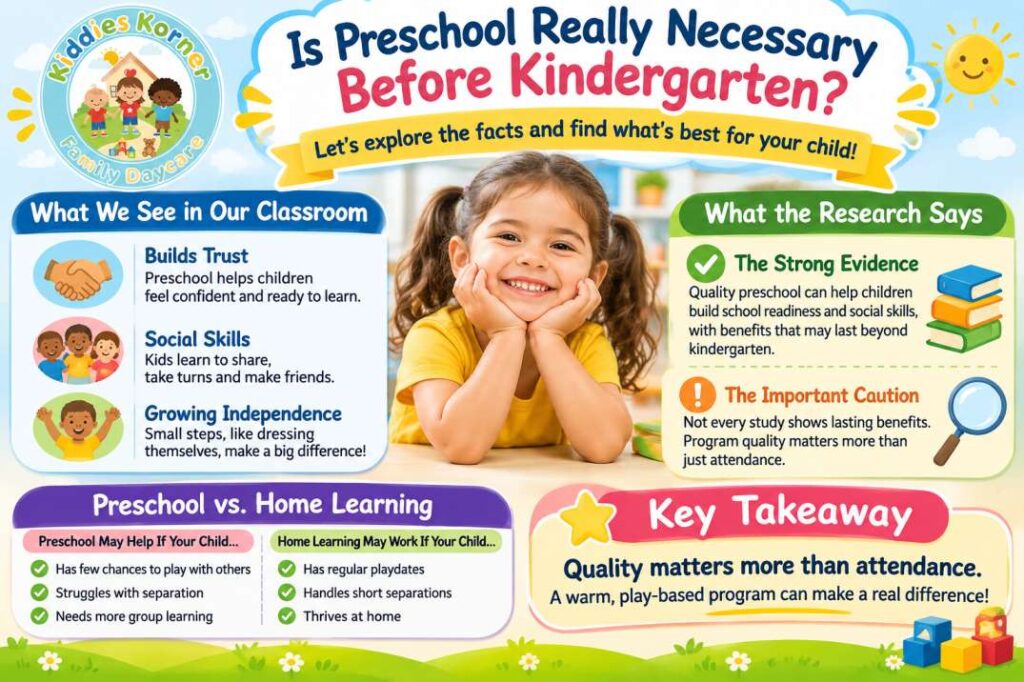
After years of caring for young children, our caregivers notice the same patterns again and again.
These patterns match what early childhood research has found for decades.
Researchers have studied preschool for more than sixty years, and the findings are clear in some areas and mixed in others.
Two well-known long-term studies, the Perry Preschool Project and the Abecedarian Project, followed children from low-income families from early childhood into adulthood. Children who attended high-quality programs were more likely to finish school and hold steady jobs as adults. These studies helped shape early education policy across the country.
Not every preschool study shows lasting benefits. A large study of a statewide pre-K program in Tennessee found that early gains faded, and some later results were worse for children who attended. Researchers point to program quality as a key reason.
The lesson is simple: quality matters more than attendance. A warm, play-based program with skilled caregivers can make a real difference. A rigid, low-quality program may not. That’s why choosing carefully matters as much as deciding to enroll.
Preschool is not a must for every child. But it offers something most homes cannot easily provide: daily practice in a group. Kindergarten is a group experience. Children must wait, share attention, follow group directions and manage feelings without a parent nearby.
Use this table to think through your own situation.
| Preschool may help most if your child… | Learning at home may work well if your child… |
|---|---|
| Has few chances to play with other children | Has regular playdates, classes or group activities |
| Struggles with separation or group settings | Already handles short separations with ease |
| Will start kindergarten within a year or two | Is still young and thriving at home |
| Needs more language-rich conversation and play | Has a caregiver at home with time for daily reading and play |
| Lives in a home where both parents work | Has a parent or relative available most days |
For many families, the real question is not “Is it necessary?” but “Will it help my child?” For most children, a quality program does.
Local factors shape this decision too. Here is what we see San Diego families weighing right now.
Bring this checklist on every tour.
| What to Check | Green Flag | Question to Ask |
|---|---|---|
| Caregiver warmth | Kneels to eye level and speaks gently | “How do you comfort a child who is upset?” |
| Learning approach | Play with clear learning goals | “What does this activity teach?” |
| Group size | Small groups with familiar adults | “How many children are in each group?” |
| Staff stability | Caregivers who have stayed for years | “How long has your team worked here?” |
| Daily routine | Balance of play, rest, meals and outdoor time | “Can I see your daily schedule?” |
| Parent communication | Regular updates and open conversations | “How will you share my child’s progress?” |
| Safety | License shared openly, clear sick policies | “Can I see your license and parent handbook?” |
When you compare toddler and preschool programs in San Diego, use the same questions at every visit. Consistent questions make it much easier to compare answers fairly.
At two, children mostly play beside others rather than with them. A good program focuses on routines, language, movement and gentle social practice. Many two-year-olds benefit from shorter days or fewer days a week at first.
Three is when many children start preschool. They begin to play cooperatively, follow simple group directions and enjoy stories and pretend play. This is often the age when group learning makes the biggest difference.
Four-year-olds are preparing for kindergarten. They practice longer attention spans, early letters and numbers, problem-solving and independence. Families at this stage often compare preschool with TK based on schedule, group size and their child’s needs.
Is Preschool Really Necessary? It is not required, but quality preschool gives most children a strong, confident start. Research and everyday classroom experience point to the same truth: the quality of the program matters more than anything else.
The right preschools for children combine play, routine and caring adults in a place where your child feels safe and excited to learn.
If you are looking for warm, family-style preschools for kids near San Diego, Kiddies Korner Family Daycare welcomes you to visit, meet our caregivers and ask us anything on this checklist. At Kiddies Korner Family Daycare, we believe every child deserves a joyful, confident start to school.
Most children start preschool around age three, but there is no single right age. Look for signs of readiness, such as interest in other children, the ability to follow simple directions and comfort with short separations. Some children are ready a little earlier, while others benefit from waiting a few months. Visit a few preschools for kids near San Diego with your child and watch how they respond before you decide.
TK is a free public school option for four-year-olds, and many families love it. However, it does not serve three-year-olds, and it usually follows a school-day schedule, so many working parents still need extra care. Some children also do better in smaller, home-like groups. Many families use preschool at age three, then choose between TK and preschool at four based on their child’s needs.
Yes, many parents do a great job at home. Read daily, talk often, count during everyday tasks and practice self-care skills like dressing and cleaning up. The hardest part to recreate is group experience. Regular playdates, library story times and classes can help your child practice sharing, waiting and listening in a group. Combining home learning with some group time works well.
Watch the caregivers first. Quality programs have warm, patient adults who speak to children at eye level and respond to their needs. Look for small groups, organized classrooms, hands-on materials and steady routines. Ask for the license and check its inspection history. When you compare the best preschools in San Diego, choose one that welcomes questions and shares clear written policies.
Quality preschools for children use play as the main way to learn. Through blocks, art, pretend play, songs and stories, children build early math, language and thinking skills. Caregivers guide this play with clear goals. Research suggests that overly academic, high-pressure programs can backfire for young children. A balanced, play-based approach builds stronger curiosity, confidence and love of learning over time.
Design & Developed by Alpha Business Designs