Call Today
(858) 269 - 7035



Finding childcare that fits your family’s budget can be challenging, especially when you want your child to receive attentive care, opportunities to learn, and a comfortable environment. For many San Diego parents, the decision involves more than comparing weekly tuition. Work schedules, commuting time, meals, holidays, and the reliability of daily care can all influence the total cost.
The good news is that finding Affordable Daycare does not have to mean compromising on your child’s well-being or early learning experiences. With a clear budget, a practical comparison process, and the right questions, you can identify childcare options that balance cost, quality, convenience, and your child’s individual needs.
Whether you are exploring a daycare center for kids for the first time or considering a change to your current arrangement, this guide explains what to look for, which expenses to calculate, and how to evaluate childcare options in San Diego.
Childcare expenses can represent a significant part of a household budget. However, the advertised tuition is only one part of the decision. Families also need to consider operating hours, additional fees, meals, transportation, and whether the provider can accommodate their regular schedule.
For example, imagine two parents comparing childcare options. One provider has a lower weekly rate but closes before either parent finishes work. The family may need to pay for additional care or arrange a separate pickup solution. Another provider charges slightly more but offers hours that align with the family’s schedule.
In this situation, the lowest advertised price may not produce the lowest overall cost.
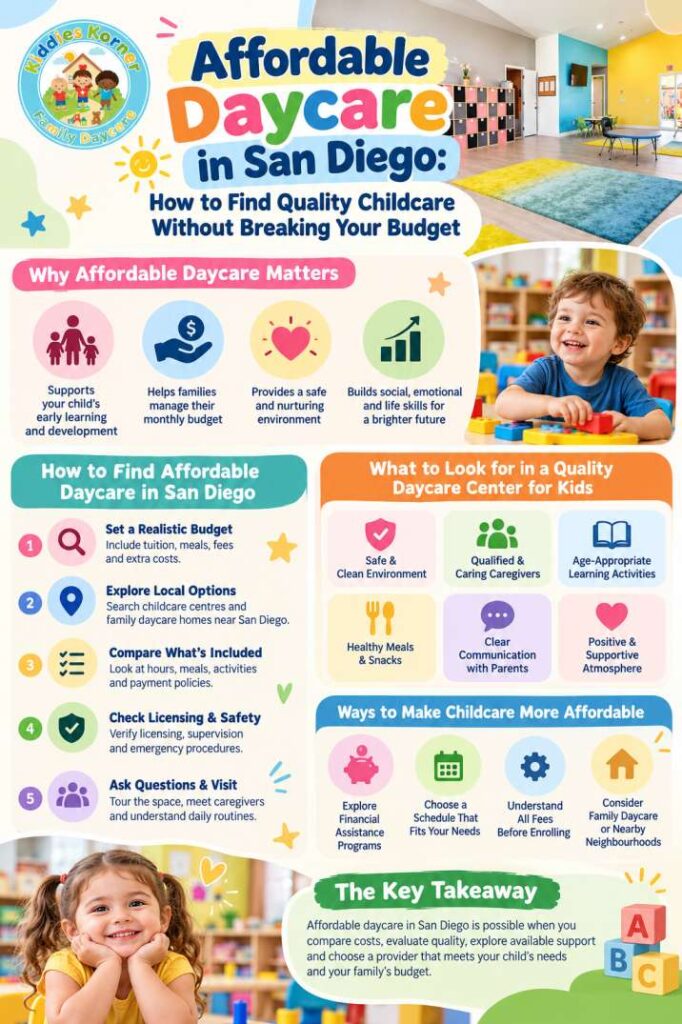
When searching for a daycare center at San Diego for kids, start by identifying your family’s practical requirements. Consider:
This information helps you narrow your choices before arranging visits or requesting detailed fee schedules.
Before comparing providers, determine how much your household can comfortably allocate to childcare each month. A realistic budget should account for both predictable payments and occasional expenses.
Ask each provider for a written breakdown of its fees. Depending on the arrangement, expenses may include:
Not every provider charges these fees, so verify each item rather than assuming it applies.
A useful calculation is:
Total monthly childcare cost = regular tuition + additional fees + related recurring expenses − confirmed assistance or discounts.
For example, suppose one option costs $250 per week and another costs $280 per week. Using a four-week budgeting estimate, their tuition would be $1,000 and $1,120 respectively. The difference is $120 over four weeks, but that calculation does not establish which option offers better value.
You would still need to compare operating hours, included services, caregiver arrangements, and any extra costs. These figures are illustrative, not current San Diego market prices.
Avoid building your budget around the maximum amount you can afford. Leave some flexibility for changes in work hours, additional care days, or other family expenses.
A childcare arrangement that appears affordable initially may become difficult to maintain if every unexpected charge creates financial pressure.
Price matters, but it should be considered alongside the quality and suitability of care. A well-informed decision balances affordability with safety, supervision, communication, and developmentally appropriate activities.
In California, the Department of Social Services oversees childcare licensing for covered childcare centers and family childcare homes. Parents can use the state’s official facility search to review available licensing information.
Before enrolling your child, ask the provider about its current licensing status, applicable capacity requirements, supervision arrangements, and emergency procedures. Review relevant records and ask questions if anything is unclear.
Licensing information is an important starting point, but it is not a complete assessment of whether a provider suits your family. Visit in person, observe the environment, and ask for current information. The state also advises families not to rely on the online search alone when making a childcare decision.
Ask how many children are present during the hours your child will attend and how supervision is maintained throughout the day.
Relevant questions include:
Applicable requirements vary according to the type of childcare setting, children’s ages, and other circumstances. Confirm the rules relevant to the specific provider rather than relying on a general ratio found online.
A smaller group may allow more opportunities for individual interaction, but group size alone does not establish quality. Caregiver attentiveness, experience, consistency, and the way the daily routine is managed also matter.
Young children learn through exploration, play, conversation, repetition, and relationships. A suitable childcare arrangement should provide age-appropriate opportunities for development rather than simply occupying children throughout the day.
During your visit, ask about activities such as:
You do not need expensive toys or elaborate facilities to support early learning. What matters is whether activities are appropriate for children’s ages, whether adults engage with them meaningfully, and whether the routine accommodates different developmental needs.
Clear communication can make a substantial difference to a family’s childcare experience.
Ask how the provider shares information about meals, naps, activities, changes in behavior, and important incidents. Find out whom to contact with questions and how urgent concerns are handled.
Reliable communication helps parents understand their child’s day and address difficulties before they become ongoing problems.
The most useful comparison looks at what each provider offers for the amount charged. Rather than choosing solely by tuition, create a shortlist and assess each option against the same criteria.
| Comparison factor | Questions to ask |
|---|---|
| Total cost | What is included in tuition, and which fees are additional? |
| Schedule | Do the hours match your work and commuting needs? |
| Safety | What supervision and emergency procedures are followed? |
| Caregiver arrangements | Who cares for the children, and how is consistency maintained? |
| Daily routine | Are meals, rest, play, and transitions planned appropriately? |
| Communication | How are daily updates and concerns handled? |
| Flexibility | What are the policies for absences, holidays, and schedule changes? |
| Location | Is pickup practical, and how much travel time is involved? |
Weekly prices can make two providers appear similar even when their annual costs differ.
Ask about scheduled closures, payment obligations during holidays, vacation policies, and whether tuition is charged when your child is absent. Clarify whether fees are refundable if your family withdraws or changes its arrangement.
For a fair comparison, calculate the expected cost over the same period and use the same assumptions for every provider.
Also consider the value of predictable arrangements. A provider that consistently meets your family’s needs may be more practical than a cheaper option that requires frequent backup childcare.
Parents searching for child daycare services near San Diego can use several methods to identify suitable options. Combining official resources with direct enquiries can help you build a more reliable shortlist.
The California Department of Social Services provides an online facility search that allows families to look up childcare facilities by location and other criteria.
You can also explore California’s Child Care Resource and Referral network. These agencies help families find childcare that meets their needs and provide information about local resources.
When contacting providers, ask whether they currently have openings for your child’s age group, what their fees include, and whether a waiting list or deposit applies.
If your preferred area has limited availability, consider nearby neighbourhoods along your regular commute. A slightly different location may provide a better combination of price, schedule, and suitability.
However, calculate the actual travel cost and time before making a decision. A lower childcare fee may not represent a saving if it adds substantial daily driving or makes pickup difficult.
When comparing a childcare center with a family daycare home, look at the actual arrangements rather than assuming one is automatically cheaper or better.
Family daycare homes may offer a home-based environment and a different group dynamic. Centers may provide a different organizational structure, staffing arrangement, or activity programme. These characteristics vary by provider.
Consider which environment is most appropriate for your child and household.
Questions worth asking include:
A home-based setting is not automatically less expensive, just as a center is not automatically more expensive. Request actual quotes and compare the full package.
For families seeking daycare services for kids, the goal should be to find an arrangement that provides suitable care while remaining financially sustainable.
Low tuition can be attractive, but it should not replace questions about supervision, licensing, caregiver arrangements, or the daily routine.
Visit the setting and ask for clear answers before making a commitment.
Registration fees, extended hours, holiday policies, and late-pickup charges can affect the real cost. Request written fee information and review the agreement carefully.
Financial assistance depends on eligibility rules and programme availability. Check official sources and confirm the details directly rather than including unapproved assistance in your budget.
Starting your search early gives you more time to compare providers, arrange visits, check availability, and understand enrolment terms.
If your preferred option has a waiting list, ask about the expected process and whether any deposit is refundable. Avoid relying on an unconfirmed opening when planning your return to work.
A provider may appear suitable on paper but still require an adjustment period for your child.
Ask how the provider supports children who feel anxious at drop-off, need help with transitions, or are becoming accustomed to a new routine. Discuss what information the caregiver would like to know about your child’s preferences and comfort needs.
Finding a sustainable childcare arrangement often involves a few small decisions rather than one dramatic cost reduction.
Plan your required hours carefully. Identify when you genuinely need care and compare available schedules. Do not assume that a part-time arrangement is cheaper until you have confirmed the provider’s pricing structure.
Ask about payment terms. Understand when payments are due, what happens during absences, and whether the provider offers any published discounts or alternative attendance arrangements.
Investigate assistance early. Contact the relevant local agency to ask about eligibility, waiting lists, application requirements, and participating providers.
Budget for the entire year. Include known holidays, planned absences, deposits, and recurring expenses in your calculations.
Keep a backup plan. Ask trusted family members or other appropriate caregivers whether they may be available in an emergency. Do not assume that your regular provider can accommodate unscheduled extensions.
Prioritise essential requirements. Safety, appropriate supervision, a suitable daily routine, and dependable communication should remain central to the decision. Optional extras can be considered after these needs are met.
Before signing an agreement, prepare a short list of questions and take notes during each visit.
Ask for important policies in writing. This allows you to review them at home and compare different options without relying on memory.
Choosing childcare is an important family decision, and affordability should be considered alongside safety, developmental needs, dependable routines, and clear communication. By comparing complete fee schedules, checking official resources, asking detailed questions, and planning ahead, San Diego parents can make a more informed choice without relying on price alone.
For families exploring their options, Kiddies Korner Family Daycare recognises the importance of finding a childcare arrangement that supports both children’s everyday experiences and parents’ practical needs. Take time to discuss your family’s schedule, understand the available arrangements, and review the relevant policies before deciding whether a particular setting is the right fit.
The aim is not simply to find the cheapest childcare option. It is to find care that works for your family, supports your child’s well-being, and fits your budget in a sustainable way.
There is no single price for all childcare arrangements in San Diego. Costs vary according to the child’s age, the provider’s type, attendance schedule, operating hours, and included services.
Request current quotes from several suitable providers. Compare the full monthly and annual costs, including additional fees and payment obligations during absences or closures. If you may qualify for financial assistance, confirm the programme’s eligibility requirements and whether funds are available before calculating your expected out-of-pocket cost.
Start by setting a realistic monthly budget and identifying your essential requirements. Search official childcare resources, shortlist providers in practical locations, and arrange in-person visits.
Compare licensing information, supervision, caregiver arrangements, daily activities, communication practices, operating hours, and total fees. A provider’s low price alone does not establish quality. The best option is one that meets your child’s needs, satisfies applicable requirements, fits your schedule, and remains affordable over time.
Not necessarily. Family daycare homes and childcare centers have different operating arrangements, and fees vary from one provider to another. A family daycare home may suit a family seeking a home-based setting, while a center may better match another family’s schedule or preferences.
Obtain actual quotes from both types of providers. Compare the total cost, operating hours, group arrangements, caregiver availability, and policies. Check the applicable licensing requirements for the specific setting before making a decision.
Some families may qualify for government-supported childcare assistance, depending on their circumstances and the programme’s rules. California’s CalWORKs Child Care programme supports eligible families who meet its requirements. Other parents can contact their local Child Care Resource and Referral agency or Alternative Payment Program for information about potentially available assistance.
Eligibility, funding, and availability can change. Consult official programme resources and ask what documents are required, whether a waiting list applies, and which providers participate.
Verify the provider’s current licensing information where applicable, understand the supervision arrangements, and observe the environment during an in-person visit. Ask about daily routines, meals, rest, age-appropriate activities, emergency procedures, illness policies, and communication with families.
Review the written fee schedule and enrollment agreement carefully. Pay particular attention to deposits, absences, holidays, withdrawal notice, and additional charges. Finally, consider whether the location, schedule, and caregiver approach are suitable for your child’s needs.
Design & Developed by Alpha Business Designs