Call Today
(858) 269 - 7035


Starting daycare is a big milestone for children and parents. For some children, meeting new educators and playing with other children is exciting. For others, being away from their parents, sleeping in a different environment, and following unfamiliar routines can feel overwhelming.
The good news is that a little preparation can make this transition easier. A child daycare and preschool center can become a comfortable place for learning, play, and social development when children have time to adjust and receive consistent support at home and in care.
This guide explains how to prepare your child for daycare routines, manage separation anxiety, establish healthy habits, and work with educators to make the first few weeks more positive.
Young children often feel more secure when they know what to expect. Predictable routines help them understand what happens next, whether it is breakfast, playtime, outdoor activities, lunch, or an afternoon nap.
At home, your child may follow a familiar schedule with parents or grandparents. Starting daycare introduces new people, different surroundings, and activities that may happen at slightly different times. Even a child who enjoys socialising can need time to adjust to these changes.
Consistent routines can help children develop independence, emotional regulation, and confidence. For example, a toddler who knows that handwashing comes before lunch may gradually begin walking towards the sink without needing repeated reminders.
Routines also provide opportunities to practise everyday skills, such as putting toys away, drinking from a cup, communicating basic needs, and recognising when it is time to rest.
However, every child develops at a different pace. Some children settle into a new schedule within days, while others need several weeks of patient support. The aim is not to make your child follow a perfect timetable before their first day. It is to help them become familiar with the kinds of activities they will experience.
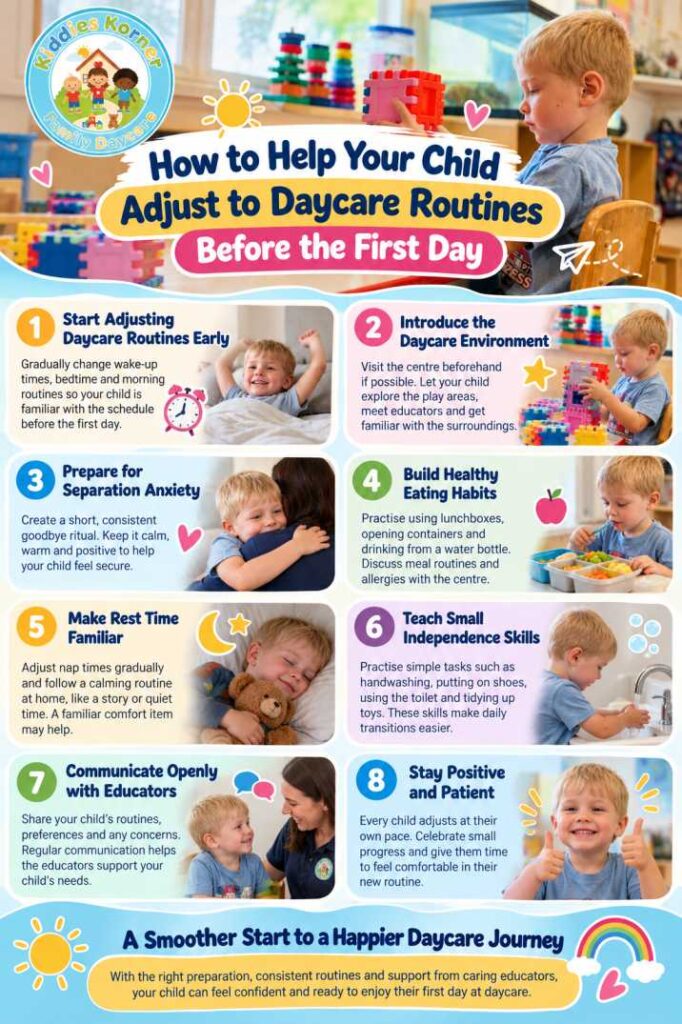
One of the most useful ways to prepare your child is to introduce small changes to their daily schedule before daycare begins. Starting one or two weeks in advance can give your family time to identify what works without changing everything at once.
If daycare starts early in the morning, begin moving your child’s bedtime and wake-up time towards the schedule they will need. Making changes gradually is often easier than suddenly asking a child to wake up much earlier on their first day.
For example, if your toddler normally wakes at 8:00 am but will need to be ready by 7:00 am, you could move their morning routine earlier in small increments over several days. Adjust bedtime accordingly so they still have enough opportunity for sleep.
Keep the routine simple and predictable. A bath, a story, quiet play, and a familiar bedtime phrase can help signal that the day is ending.
Try following a daycare-style morning at home. This might include getting dressed, washing hands and face, eating breakfast, packing a bag, and leaving the house at a consistent time.
You do not need to recreate every part of daycare. The goal is to help your child become familiar with the sequence of activities.
If getting dressed is difficult, offer two suitable clothing choices rather than asking an open-ended question. Small decisions give children a sense of control while keeping the morning manageable.
Unfamiliar surroundings can make the first day feel more intimidating. If the centre offers an orientation visit or settling-in session, take advantage of it.
A short visit can help your child see the play areas, meet educators, and explore the environment while you are nearby. They may discover a favourite toy, a reading corner, or an outdoor play space that gives them something familiar to look forward to.
Use simple, reassuring language to explain the upcoming change. You might say, “You will play with other children, have lunch, and then I will come back to pick you up.”
Avoid promising specific activities unless you know they will happen. It is more helpful to describe the general routine and explain that the educators will help your child throughout the day.
You can also read picture books about starting daycare or pretend to run a little childcare centre at home. Let your child take turns being the educator, the parent, and the child. Play can help them express feelings they may not yet have the words to explain.
Before starting, give your child opportunities to practise age-appropriate tasks, such as:
These skills can make daily transitions easier, but they should not become a source of pressure. Educators expect young children to need support, and independence develops through repeated practice.
Separation anxiety is common in early childhood, particularly when children encounter unfamiliar people or environments. A child may cling to a parent, cry at drop-off, refuse to enter the room, or become unusually quiet.
These reactions can be upsetting for parents, but they do not automatically mean daycare is unsuitable. Your child may simply need time to build trust with their new educators.
A predictable goodbye can help children understand that separation is happening and that their parent will return. You might give a hug, say a familiar phrase, wave at the door, and then leave.
Keep your goodbye warm and calm. Repeatedly returning to the room after saying goodbye can sometimes make the separation more confusing because the child has to experience the departure several times.
Do not sneak away without telling your child. Although it may avoid tears in the moment, it can make some children more anxious about whether their parent will disappear unexpectedly.
Imagine a three-year-old who cries whenever their parent reaches the daycare entrance. The educator welcomes the child, offers a familiar activity, and helps them settle while the parent follows the agreed goodbye routine.
The parent may still hear crying as they leave. Rather than assuming the entire day will be distressing, they can ask the educator for an update about how long the child took to settle, whether they joined activities, and whether they ate or rested.
Progress might mean crying for a shorter period, accepting comfort from an educator, or beginning to play independently. These small changes are meaningful even if drop-off is not immediately tear-free.
Meals and rest periods can be challenging because children may be accustomed to eating or sleeping in particular ways at home.
You can help by discussing the centre’s usual meal and rest schedule in advance. Ask whether children bring their own food, how allergies are managed, what happens if a child does not eat, and whether rest time requires children to sleep or simply relax quietly.
If your child will eat from a lunchbox, practise opening containers and drinking from their water bottle. Choose practical, age-appropriate packaging that your child can manage with the assistance available at the centre.
If meals are provided, share important dietary needs and food allergies with the educators before the first day. Do not assume that staff will know about restrictions unless you have communicated them clearly through the centre’s required process.
Avoid using food as a reward for adjusting quickly. Children may need time to become comfortable eating in a new environment, and pressure can make mealtimes more stressful.
Ask about the daycare’s nap schedule and settling practices. If your child’s usual nap is much later than the centre’s rest period, discuss how to manage the transition.
At home, you can practise a calming pre-nap routine with a story, soft music, or quiet time. If the centre permits a familiar comfort item, such as a small blanket or soft toy, it may help your child feel more secure.
Remember that a child does not need to fall asleep on demand to be adjusting well. Learning to rest in a group environment can take time.
Parents often feel more confident about the transition when they know how the centre supports children during their first days. If you are comparing a child daycare and preschool center near me, look beyond opening hours and location. Consider how the educators communicate, handle distress, support routines, and respond to individual needs.
A useful conversation with the centre can cover several practical matters:
A centre’s answers can help you understand its approach to care and whether it suits your family’s needs.
For families exploring a child daycare and preschool service in San Diego, it is also important to check the provider’s licensing status, policies, staff qualifications, and applicable local requirements. These checks offer a more reliable basis for choosing care than relying on photographs or online reviews alone.
Children do not always express worry directly. A child may become clingier at home, have more tantrums, resist bedtime, or ask repeatedly whether a parent will return.
Instead of dismissing these feelings, acknowledge them in a way your child can understand. You might say, “You wanted me to stay. It is hard to say goodbye, and your educator will help you while I am away.”
This approach recognises the child’s emotion without suggesting that daycare is dangerous or that the parent is uncertain about leaving.
Tell your child when you will return using an event they understand, such as after afternoon tea or outdoor play, rather than relying only on clock times.
Keep your promises whenever possible. If collection arrangements change, explain the change simply and ensure the educator knows who is authorised to collect your child.
A familiar family photograph or permitted comfort object may also help. Check the centre’s policies first, particularly where small objects could present a safety risk.
Preparing for daycare should make the transition easier, not create a long list of expectations your child must meet before attending.
Moving bedtime, changing food habits, stopping comfort routines, and introducing independent dressing in the same week can overwhelm some children. Focus on the changes that matter most for daycare and introduce others gradually.
Young children learn through repetition and support. A child who needs help putting on shoes or remembering to wash their hands is not necessarily unprepared for daycare.
One child may run into the room on the first morning, while another needs an educator to accompany them inside. Temperament, previous experiences, age, and familiarity with group settings all influence adjustment.
Compare your child’s progress with their own earlier behaviour rather than another child’s timeline.
Some upset is expected, but ongoing or worsening distress deserves attention. Speak with the educators if your child remains very distressed, struggles to participate, or shows significant changes in sleep, eating, or behaviour over time.
If you have concerns about your child’s wellbeing or development, consider discussing them with your child’s healthcare professional. There is no need to wait until a problem becomes severe before seeking guidance.
The first week is an opportunity to learn what helps your child feel safe. Keep mornings as calm as possible by preparing clothes, bags, food, and other essentials the night before.
After collection, allow some quiet time. Children may be tired from managing new experiences, social interactions, and sensory stimulation. A simple afternoon at home can be more helpful than adding several activities to an already demanding day.
Ask the educator focused questions rather than only asking whether your child was good. For example, find out what helped them settle, whether they interacted with other children, how they managed meals, and which part of the routine seemed difficult.
Use these observations to make small adjustments at home. If your child becomes tired before dinner, an earlier bedtime may help. If drop-off is hardest when rushed, preparing everything the night before may reduce stress.
Consistency is important, but flexibility matters too. A routine should support your child, not become a strict schedule that ignores their individual needs.
Helping your child adjust to daycare routines begins with small, practical steps. Gradually adjust sleep and morning schedules, introduce the new environment where possible, practise age-appropriate independence, and create a calm goodbye ritual. Most importantly, give your child time to build trust with their educators.
A supportive child daycare and preschool center should work with families to understand each child’s needs and provide consistent reassurance during the transition. For parents considering Kiddies Korner Family Daycare, asking about orientation, settling-in support, daily routines, and parent communication can help you make an informed decision.
With patience, preparation, and cooperation between home and daycare, the first day can become the beginning of a positive learning experience rather than a change your child has to manage alone.
There is no fixed adjustment period. Some children become comfortable within a few days, while others need several weeks or longer to feel secure. The transition depends on the child’s age, temperament, previous group-care experience, and relationship with the educators. Look for gradual progress, such as accepting comfort, joining activities, or becoming more relaxed at drop-off. If distress persists or increases, discuss a tailored settling-in plan with the centre.
Crying alone does not necessarily mean you should stop attending. Many children become upset during separation but settle after their parent leaves. Follow the agreed goodbye routine and ask the educator to update you about how your child manages afterwards. If the child remains distressed for long periods, cannot participate, or shows ongoing changes in wellbeing, work with the centre to review the transition and consider additional professional guidance if needed.
Start by learning the centre’s rest schedule and settling practices. Gradually adjust your toddler’s sleep routine if necessary, and practise a calming sequence before naps at home. A familiar comfort item may help if the centre permits it. Avoid forcing sleep or making your child feel they have failed if they do not nap. The goal is to help them become comfortable with quiet rest while educators support their individual sleep needs.
Children do not need to master reading, writing, dressing, or independent toileting before starting care. Helpful skills include expressing basic needs, accepting support from a trusted adult, practising handwashing, and becoming familiar with simple routines. The exact expectations depend on the child’s age and the centre’s programme. Share your child’s strengths, communication style, allergies, and support needs with educators so they can help the child participate comfortably.
Start by sharing useful information about your child’s routines, comfort strategies, communication, sleep, food preferences, and any relevant health or developmental needs. Agree on a consistent goodbye routine and ask for practical feedback about how the child settles during the day. If difficulties arise, discuss specific observations and possible adjustments rather than assuming one approach will work for every child. Regular, respectful communication helps both home and daycare provide consistent support.
Design & Developed by Alpha Business Designs