Call Today
(858) 269 - 7035


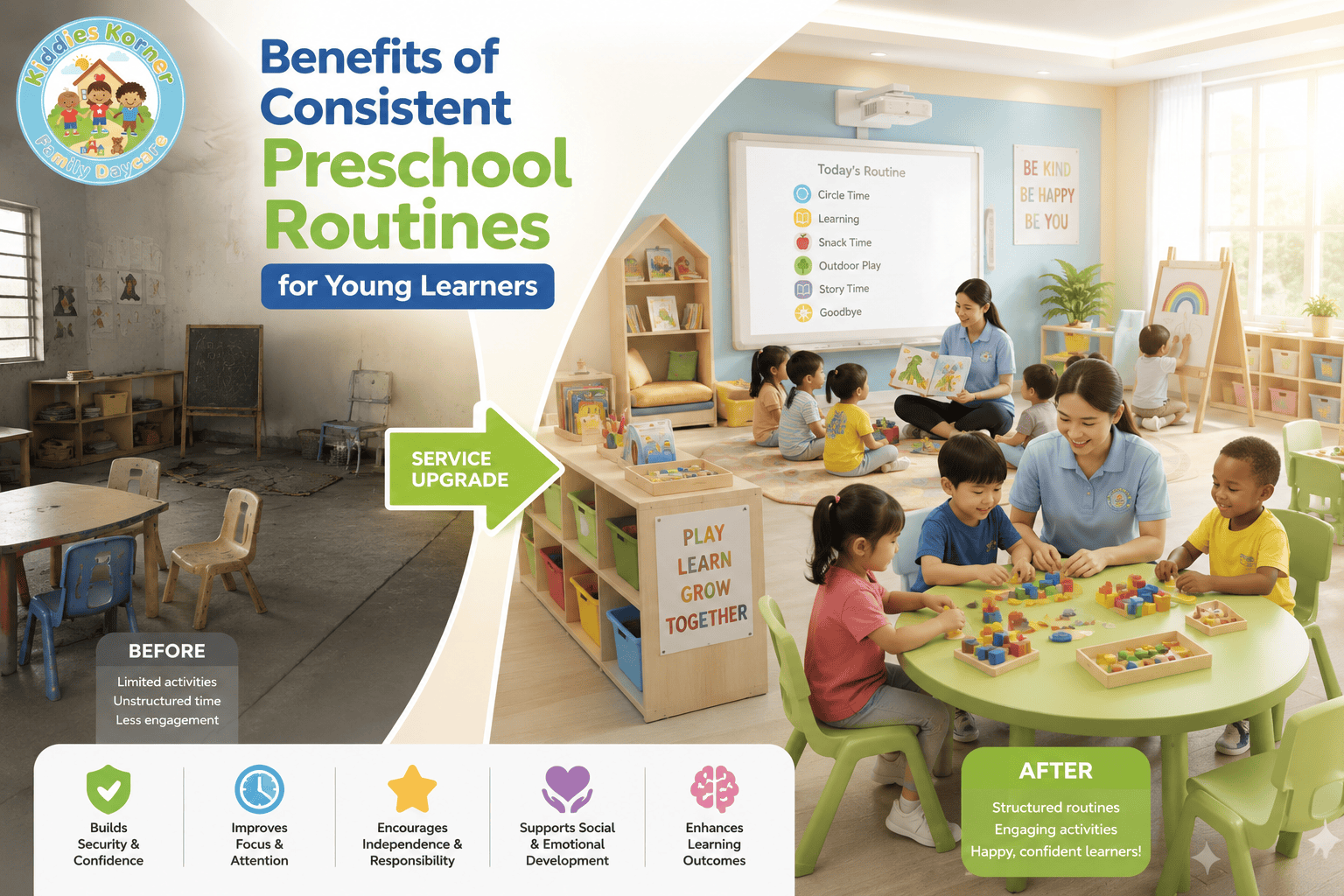
For young children, the world can often feel unpredictable and overwhelming. That’s why preschool routines play such a powerful role in shaping early learning experiences. At Kiddies Korner Family Daycare, we believe that a well-structured schedule is more than just organization – it builds emotional security, encourages independence, and supports long-term development.
Little ones often adjust quicker when days unfold in familiar ways. Circle time, munching on snacks, even running around – these moments build comfort through repetition. Active involvement grows where rhythm lives. Skills bloom quietly under steady rhythms. Stability shows up most clearly in what comes next, again and again.
Little kids lean on repetition when figuring out how the world works at first. Day after day doing similar things builds a structure helping them grow, setting clear ideas of what comes next while making surprises less jarring.
Kids calm down when they can guess what happens after. Because of that quiet feeling inside, their minds stick to school stuff instead of jumping at surprises. Slowly, doing things the same way each day teaches them how long minutes really are, along with how to handle their own actions – key pieces for doing well in classrooms later on.
From experience, educators often notice that children who follow structured routines show improved behavior, better attention spans, and stronger peer interactions. These foundational skills extend well beyond preschool years.
Inside a thoughtful early childhood space, setup matters more than stuff. Not because rules kill fun, but because predictability helps tiny humans breathe. Each recurring moment stitches calm into chaos, turning hours into something felt, not rushed.
Typical structured routines include:
One part follows another, each holding its place – learning folds into motion, then gives way to stillness. With repetition, kids start to sense what comes next, leaning in without being asked.
Most days, when class rules stick, kids move quicker from one task to another without fuss. Because of that, lessons stretch further, leaving room for real talk and work.
The benefits of consistent preschool routines for child development go far beyond daily organization. They influence multiple aspects of a child’s growth:
When kids understand what comes next, a quiet confidence grows. Knowing the pattern ahead eases their worries – emotion regulation becomes more reachable because of it.
When days follow a pattern, kids begin to know what comes next. Little by little, doing things the same way helps them understand how to act.
Through daily routines, group tasks help children exchange ideas while learning to work together. Moments of interaction build trust because shared experiences shape how kids respond to one another.
A structured daily schedule allows children to focus better, leading to improved retention and engagement.
Simple routine tasks—like cleaning up toys or preparing for activities—help children develop independence.
These gains show up for real, seen again and again in varied preschool environments – not just guessed at by experts.
Looking closely at daily classroom moments reveals how useful regular practices can be. For example:
In real-life observations, when kids face early challenges, they tend to adjust fast if daily patterns settle in. After several weeks, changes in how they act and join in become clear.
At Kiddies Korner Family Daycare, routines are designed with both structure and flexibility in mind. Instead of rigid schedules, the focus is on creating a balanced environment where children feel guided but not restricted.
Daily routines are thoughtfully planned to include:
By following this method, kids stay involved as they build key abilities through everyday experiences.
From experience, environments like Kiddies Korner Family Daycare show that when routines are implemented correctly, children become more confident, expressive, and adaptable.
Most habits form only after careful thought goes into each step. Still, timing often matters more than people expect when building daily patterns. Here are some practical strategies based on real-world experience:
Start with simple habits, after which layers of challenge follow once kids adjust. Later steps emerge naturally when early patterns take hold.
What matters most is regularity. When kids follow an identical routine each day, they begin to absorb its structure naturally.
Charts, pictures, or signals help children understand what comes next.
While structure is important, some flexibility ensures children don’t feel restricted.
Encourage children with praise when they follow routines successfully.
Educators often find that small adjustments—like using songs for transitions—can significantly improve engagement and cooperation.
Even well-intentioned routines can fail if not implemented correctly. Here are some common pitfalls:
Too many activities can overwhelm children and reduce effectiveness.
Frequent changes disrupt the sense of security routines are meant to provide.
Most routines work better when they spark engagement instead of just repeating the same flat actions.
Every child is different. Routines should allow room for personal comfort and pace.
From experience, the most successful routines are those that balance structure with adaptability.
Experienced educators emphasize that routines should evolve with the child. What works for a toddler may not work for an older preschooler.
Some proven approaches include:
At Kiddies Korner Family Daycare, these principles are applied daily, ensuring that routines remain effective and engaging.
The impact of strong preschool routines extends far beyond early education. Children who grow up with structured routines often:
These long-term benefits highlight why routines are not just a convenience, they are a critical part of early development.
Consistent preschool routines are one of the most effective tools for supporting young learners. They provide structure, build confidence, and create an environment where children can truly thrive.
From emotional stability to improved learning outcomes, the benefits are both immediate and long-lasting. When implemented thoughtfully, routines become a foundation for lifelong success.
At Kiddies Korner Family Daycare, the focus on structured yet flexible routines ensures that children experience the best of both worlds – guidance and freedom. Starting strong, this method supports children as they become more sure of themselves and able to handle what comes next.
Preschool routines create stability, reduce anxiety, and help children feel secure while supporting consistent learning behaviors.
They improve emotional regulation, focus, independence, and social skills through repetition, structure, and predictable daily experiences.
It includes structured learning, free play, meals, rest time, and activities supporting balanced growth and development.
Most children adapt within days or weeks when routines remain consistent, predictable, and reinforced positively.
Routines should remain consistent but flexible enough to adjust based on children’s needs, comfort, and daily situations.
Design & Developed by Alpha Business Designs