Call Today
(858) 269 - 7035


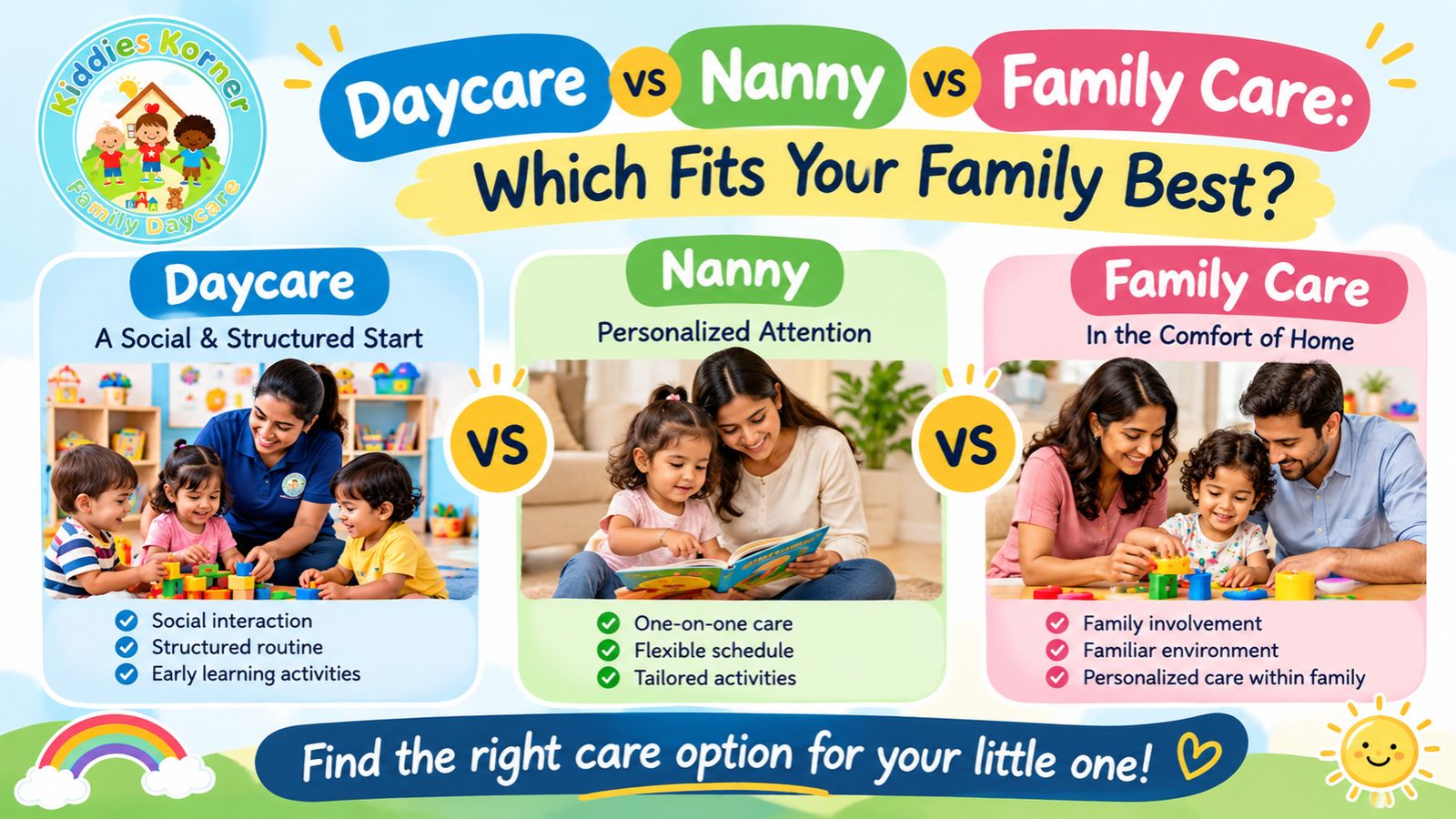
Your parental leave is ending, and the big question lands on the kitchen table: who will care for your child? Your mother offers to help. A coworker swears by her nanny. A friend says daycare changed her toddler’s life. Everyone means well, but their advice pulls you in three directions.
The truth is simple. No single option suits every family. Quality daycare services for kids work beautifully for some families, while a nanny or a grandparent works better for others. The right choice depends on your schedule, your child and your budget.
This guide breaks down Daycare vs Nanny vs Family Care in plain terms. You will see what each option really offers, where each one falls short and how real families make the decision.
Before you compare, it helps to know what each option means in daily life. The labels sound simple, but the experience behind each one is very different.
A daycare center for kids provides group care in a setting built for young children. Trained caregivers follow a daily routine of play, learning, meals and naps. Children spend time with others their own age, which builds sharing, patience and language skills. Daycares also follow state licensing rules, so an outside agency checks safety, staffing and health practices.
A nanny cares for your child in your own home. Your child gets one-on-one attention and stays in familiar surroundings. Nannies can often adjust to unusual work hours. However, hiring a nanny usually makes you an employer. That can bring payroll, tax and contract duties, so many families speak with a tax professional before they hire.
Family care means a relative, often a grandparent, aunt or older cousin, looks after your child. Your child stays with someone who already loves them. Many families value the shared culture, language and traditions. Note that family care is not the same as a licensed family daycare, which is a professional program run in a home setting.
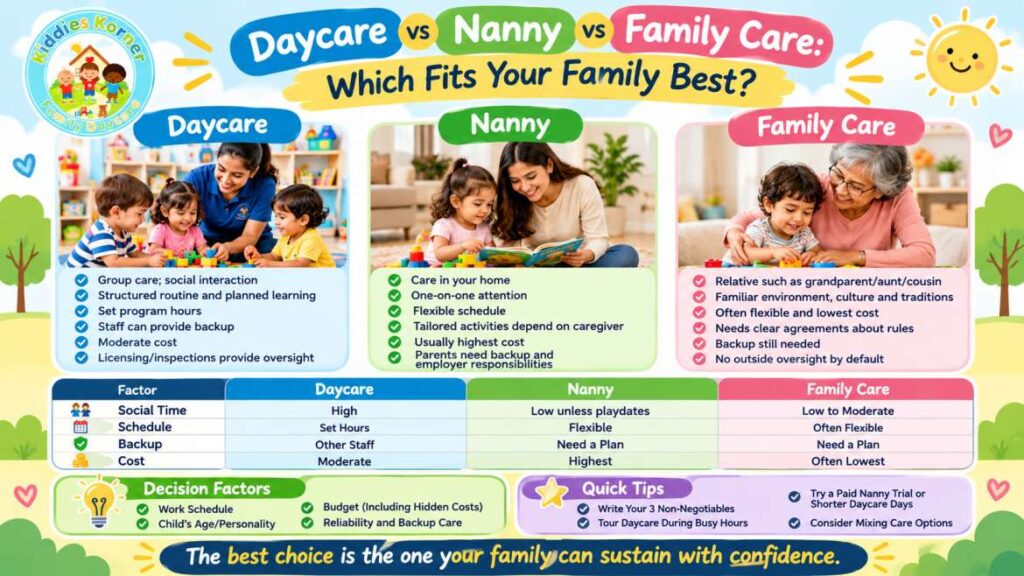
Use this table to compare the three options side by side.
| Factor | Daycare | Nanny | Family Care |
|---|---|---|---|
| Social time with other kids | High, every day | Low unless you plan playdates | Low to moderate |
| Structured learning | Planned daily activities | Depends on the nanny | Depends on the relative |
| Schedule flexibility | Set program hours | Most flexible | Often flexible |
| Backup when caregiver is sick | Other staff cover | You need a backup plan | You need a backup plan |
| Outside safety oversight | State licensing and inspections | None by default | None |
| Relative cost level | Moderate | Usually highest | Often lowest |
| Your role | Parent and partner | Employer and manager | Family member and guest |
Start with your hours. If you work a regular weekday schedule, daycare fits easily. If you work nights, weekends or rotating shifts, a nanny or relative may cover the gaps better. Many parents in healthcare, hospitality and first-response jobs use a mix of options to cover every shift.
Infants need close, consistent care, and many parents feel more relaxed with one caregiver early on. Toddlers and preschoolers often thrive with other children around. A shy child may need a gentle, small-group setting. A busy, curious child may love the variety that daycare services for kids bring each day.
Look beyond the obvious price tag. A nanny may need paid time off, raises and payroll costs. Family care may seem free, but you may cover food, outings or a relative’s travel. Daycare usually comes with a clear, predictable fee. List every cost before you compare.
Ask what happens when the caregiver is sick. A daycare has other staff who step in. A nanny or grandparent who falls ill leaves you scrambling. If your job has little flexibility, reliability may matter more than any other factor.
These examples show how different families reach different answers.
Many parents want the warmth of family care with the structure of daycare. A family daycare setting offers exactly that mix: a home-like space, familiar caregivers and a steady daily routine with planned play and learning.
At Kiddies Korner Family Daycare, we welcome families who are still weighing their options. If you are searching for a trusted daycare center at sandiego for kids, we invite you to visit, ask questions and see our daily routine for yourself.
When you weigh Daycare vs Nanny vs Family Care, focus on your schedule, your child’s personality and your need for reliable backup. Each option can give your child a loving start. The best choice is the one your family can sustain with confidence.
If your family values social growth, steady routines and caregivers who partner with parents, daycare services for kids may be your best fit. Group care gives children daily chances to play, share and learn alongside friends their own age.
When you are ready to explore your options, Kiddies Korner Family Daycare would be glad to show you how a warm, family-style daycare center for kids supports children and parents alike.
Both can support healthy development, but in different ways. A nanny offers one-on-one attention, which helps with close bonding and individual routines. Daycare gives toddlers daily practice with sharing, taking turns and solving small conflicts with other children. Many toddlers also pick up new words faster around peers. Think about your child’s temperament. A social, curious toddler often thrives in group care, while a very sensitive child may need a smaller setting.
Yes, and many families do exactly that. A common plan has a grandparent care for the child two or three days a week, with daycare on the other days. Your child gets family bonding and also learns to play with other children. The key is consistency. Keep the weekly pattern steady, and share routines, nap habits and comfort words between home, relatives and caregivers so your child feels secure.
Have a clear, friendly conversation before the first day. Agree on meals, naps, screen time, discipline and safety rules, such as car seats and safe sleep. Discuss how you will thank or support your relative, whether through help with costs or regular breaks. Also plan for sick days and holidays. Writing these points down prevents misunderstandings and protects the relationship you both value.
Look for small signs of readiness. Your child may show interest in other children, follow simple routines or handle short separations from you. Even if your child cries at first, that does not mean they are not ready. Most children settle with time, warm caregivers and a steady goodbye routine. Start with a visit or shorter days if possible, and talk with caregivers about how your child is adjusting.
Family care means a relative looks after your child, usually without training requirements or outside checks. A family daycare is a licensed child care program run in a home setting by trained caregivers. It follows state rules on safety, health and group size, and it offers planned routines and learning activities. Many parents choose a family daycare because it combines a home-like feel with professional care and oversight.
Design & Developed by Alpha Business Designs