Call Today
(858) 269 - 7035


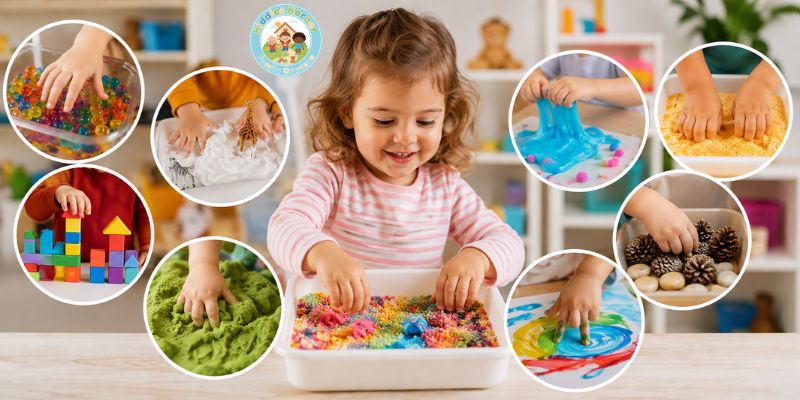
Children develop sensory understanding of the world around them from birth. All the textures that they touch, all the sounds they hear, the smells that they feel, and all the objects that they experience contribute to the formation of neural pathways in their brains that make it possible for them to learn and grow. That is why it has been established as an integral part of the modern high-quality toddler program.
The reason why parents view sensory activities as only a form of entertaining their child is the fact that there is a lack of awareness of the significance of the process in the child’s development. Harvard University’s Center on the Developing Child says that the first five years of a child’s life constitute one of the periods when the child’s brain develops significantly. One million neural pathways are developed each second in the first five years of the baby’s life, and positive hands-on experiences promote these developments. CDC states that interactive play contributes to the cognitive, social, emotional, language, and physical development of the child in early childhood. That is why good preschools in San Diego incorporate structured sensory activities in their programs. Through different toddler programs, your child can be engaged in different sensory activities, which will result in skill development.
Sensory play uses one or several of the child’s senses:
Through sensory play, children learn how to:
In contrast with structured lessons, sensory play allows kids to try things out without being afraid to make mistakes.
Water has always been one of the favorite sensory experiences for toddlers.
Some basic examples may involve:
Think of a toddler playing with cups, filling and emptying containers in an outdoor water table. This seemingly simple game teaches him such skills as volume perception, the force of gravity, coordination, cause and effect, and some early math skills. Many toddler programs feature supervised water play for kids to naturally explore and improve fine motor skills.
Sensory bins provide unlimited possibilities for discovery. They can contain:
Kids like to scoop, sort, hide things, and look for treasures. Such activities help develop finger muscles necessary for writing and drawing in the future.
Finger painting involves multiple senses at once. Toddlers have an opportunity to feel:
In contrast to coloring within given lines, there are no limitations in finger painting. Adults often value the result of their child’s work, while early childhood educators know that the process is the most important thing.
Play dough is still one of the most important sensory activities to help toddlers develop their skills. The little ones squeeze, mold, flatten, and shape the dough to create various forms and objects. Through such actions, children exercise and strengthen the muscles needed for:
Introducing cookie cutters, rolling pins, or natural elements like leaves will only add more sensory value.
All sensory activities do not necessarily require special equipment. Nature is an amazing sensory playground. When taking toddlers on walks outside, they are exposed to:
For instance, a preschool group in San Diego could be engaged in collecting various items from nature such as pine cones, smooth rocks, and colorful leaves to talk about them later in class. Outdoor sensory activities encourage physical exercise and wonder about nature.
6. Music and Movement
While music stimulates hearing, movement builds balance and coordination.
Activities include:
Studies have shown that music has a positive effect on language development, listening skills, and memory in early childhood. Children can develop many social skills in musical group activities.
Bubble play is an activity that involves visual tracking, movement, and coordination.
Toddlers enjoy:
These fun activities promote gross motor skill development and introduce concepts of air movement and cause-and-effect relations. Children also have a chance to laugh together and communicate through bubble games.
A texture board helps a child feel various textures. These textures include:
A child is introduced to rough and smooth surfaces while developing his/her vocabulary.
Teachers use terms like:
Cooking provides toddlers with many sensory experiences. Children experience:
For instance, making a fruit salad enables toddlers to touch strawberries, smell oranges, notice colors, and mix the ingredients. Cooking helps build self-reliance and promote healthy eating practices. A majority of the preschools available for children in San Diego offer age-appropriate cooking activities in their weekly programs.
Activities that encourage movement can be used by children to enhance body awareness.
Indoor and outdoor obstacle courses may consist of the following:
All these activities contribute to the enhancement of:
Children always perceive obstacle courses as adventures and not exercises.
Toddler programs ensure proper planning of sensory activities rather than relying on them to happen randomly. Teachers know that different children react to different types of stimuli. There are toddlers who get excited about messy play right away. Others need some time to be coaxed into playing. Experienced educators notice which type of stimulation is enjoyable for particular children. A personalized approach makes children feel safe and promotes healthy development.
When Mateo enrolled into a preschool designed for San Diego toddlers, his parents realized that their son didn’t say a lot when playing in groups. His teachers decided to provide him with daily sensory activities such as water play, play-doh sessions, music and nature exploration.
Instead of putting direct questions to him, they let him explore through sensory play. During several months, Mateo learned to communicate with other kids while talking about the things he discovered through sensory activities. Mateo’s parents were pleasantly surprised by how effective sensory play was.
Parents do not have to buy costly educational toys in order to foster their children’s sensory skills. They can organize a lot of interesting activities by utilizing common things found at home.
Some examples are:
It is not about doing everything perfectly but about constant possibilities to explore.
When choosing the right preschool for your children in San Diego, you shouldn’t pay attention only to the room décor. It is important to find out how sensory learning will be introduced into the curriculum. Any good preschool usually provides:
Sensory learning is not just about fun; it is perhaps the most efficient method of ensuring proper development of toddlers in the early childhood stage. Playing with water, finger painting, listening to music, exploring nature, and obstacle courses are all examples of sensory activities that will assist children in acquiring necessary cognitive, motor, linguistic, and social skills.
Children exposed to sensory activities on a consistent basis can be said to have gained invaluable experiences that will serve them well throughout their lives. Parents looking for a preschool in San Diego for their toddlers should go for those preschools where sensory learning is a key part of the educational process. Kiddies Korner Family Daycare can be the best choice for your child if you are opting for toddler programs.
These activities involve engaging at least one sense in a toddler through touch, sight, sound, movement, smell, or taste.
They help children develop brainpower, language skills, motor coordination, emotional control, creativity, and problem-solving abilities.
Simple sensory stimulation can start from birth, while toddlers generally enjoy interactive sensory experiences from ages 1-3 years.
Provided it is done under close supervision with appropriate materials that cannot be choking hazards.
Every day; even shorter periods of 15-30 minutes are helpful.
Design & Developed by Alpha Business Designs