Call Today
(858) 269 - 7035


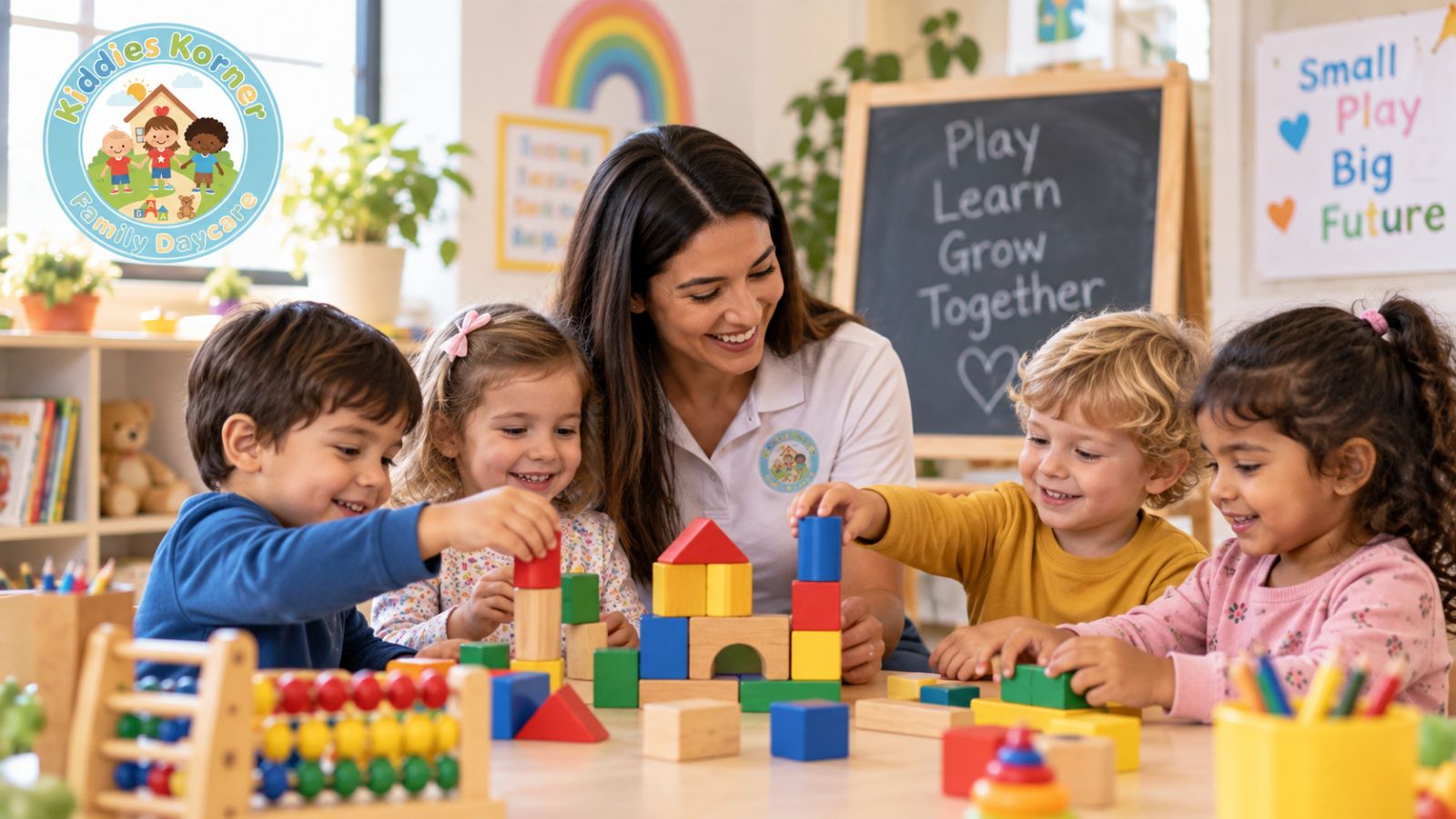
For young children, learning does not always look like sitting at a desk, completing worksheets, or memorising information. Much of the most meaningful learning happens when children are building with blocks, pretending to run a shop, painting, asking questions, solving small problems, or playing alongside friends. This is why the Benefits of Play-Based Learning have become an important consideration for parents choosing a child daycare and preschool center. A thoughtfully designed play environment can support language, confidence, social skills, creativity, problem-solving and early academic development while allowing children to learn in ways that are appropriate for their age.
Play-based learning is an approach where children develop knowledge and skills through purposeful play. It does not mean that children are simply left to entertain themselves throughout the day. Effective play-based education combines child-led exploration with intentional guidance from experienced educators.
A teacher may provide materials, introduce a question, model a new skill, or create an activity that encourages children to investigate a particular concept. The children then have opportunities to explore, experiment and make decisions.
For example, a preschool educator might provide blocks, toy vehicles and simple road signs. Children may begin by building a road. As they play, the educator can introduce ideas about shapes, counting, direction, cooperation and vocabulary. One activity can therefore support several areas of development without turning the experience into a formal lesson.
Young children naturally learn by doing. They touch objects, move around, repeat actions, ask questions and imitate people around them. Play gives them opportunities to practise these behaviours in a safe environment.
A child who repeatedly builds a tower and watches it fall is not simply playing with blocks. They are experimenting with balance, height, cause and effect, spatial relationships and persistence. When another child joins the activity, the learning expands to include communication, sharing and negotiation.
This is one reason play is such a valuable part of early childhood education.
The Benefits of Play-Based Learning extend across cognitive, social, emotional, physical and communication development. Children do not develop these abilities separately. They often practise several skills at the same time during everyday activities.
A well-planned preschool environment can therefore use play as a practical pathway for supporting children’s overall development rather than focusing only on early academic tasks.
Children encounter small challenges throughout play. A puzzle may have a difficult piece. A block structure may keep falling. A pretend shop may run out of items. A group project may require children to decide how to divide materials.
These situations encourage children to think about possible solutions.
Rather than immediately providing the answer, an educator can ask questions such as:
This approach helps children understand that problems can have more than one possible solution. It also encourages persistence when the first attempt does not work.
Language development happens naturally when children have reasons to communicate. During imaginative play, children may create stories, explain their ideas, give instructions, ask questions and respond to their friends.
A pretend restaurant, for example, can introduce vocabulary such as menu, customer, order, kitchen and payment. Children may practise phrases such as “What would you like?” or “Your food is ready.” The educator can extend the experience by introducing new words and encouraging children to describe what they are doing.
Group play can create valuable opportunities for children to listen to others and express themselves. They learn that communication is not only about speaking. It also involves waiting, listening, responding and recognising another person’s perspective.
For a child who is initially quiet, structured play can provide a less pressured reason to communicate. They might first participate by handing another child a toy and gradually begin talking about what they are building or pretending.
These everyday interactions can help build communication confidence over time.
Children need opportunities to practise social behaviour rather than simply being told how to behave. Play provides realistic situations where cooperation, patience and emotional regulation become relevant.
A child might want the same toy another child is using. Another child might change the rules of a game. A group might disagree about what to build. These moments can be challenging, but they also provide opportunities for learning.
An experienced educator can help children name their feelings, understand another child’s viewpoint and work towards a solution without taking over every interaction.
Play also gives children choices. They may decide what materials to use, where to begin or how to approach a challenge. Having appropriate control over small decisions can help children become more confident in their abilities.
For example, during an art activity, an educator does not need to tell every child exactly what their picture should look like. Providing different materials and allowing children to experiment can encourage creativity and independent decision-making.
The objective is not to produce identical artwork. It is to give children opportunities to explore and express their ideas.
Not all play takes place at a table. Movement-based activities are equally important during early childhood.
Running, jumping, balancing, climbing, throwing and catching can support gross motor development. Activities such as drawing, threading beads, building with small blocks and using playdough can help strengthen fine motor skills.
These abilities become useful for everyday tasks and later classroom activities.
A balanced preschool environment can provide both indoor and outdoor experiences. Outdoor play may give children opportunities to investigate natural materials, observe insects, practise balance or participate in physical games.
Indoor play can support quieter forms of exploration, including puzzles, construction, pretend play, books and creative activities.
The two environments can complement each other rather than functioning as completely separate parts of the day.
Parents searching for a child daycare center in san diego may naturally focus on practical factors such as location, hours, availability, safety and cost. These are important considerations, but the learning environment deserves equal attention.
Parents should look beyond attractive classrooms and ask how children actually spend their time.
When visiting a centre, consider asking:
The answers can provide a clearer picture of the centre’s educational philosophy than promotional descriptions alone.
A preschool and daycare center for kids in san diego can incorporate play-based learning in many different ways. There is no single activity or classroom arrangement that guarantees a strong learning experience.
Quality comes from how educators observe children, plan experiences, introduce challenges and respond to individual needs.
For instance, if several children are interested in insects, educators might build activities around that interest. Children could examine pictures, create insect models, count legs, read stories, draw observations and search for insects outdoors. The same interest can support science, language, mathematics, creativity and physical exploration.
Play-based learning works particularly well when educators know when to step in and when to allow children to explore independently.
If a child cannot complete a puzzle, immediately doing it for them removes the opportunity to develop persistence. Instead, an educator might offer a hint or encourage the child to compare shapes.
Similarly, if two children disagree during pretend play, an educator can help them communicate rather than simply deciding who is right.
This type of intentional guidance turns ordinary play into meaningful learning.
A strong programme does not need expensive or complicated equipment. Everyday materials can create rich learning experiences when used thoughtfully.
Blocks, magnetic tiles and recycled materials can support spatial awareness, planning and early mathematical thinking. Children can compare sizes, count pieces, create patterns and test whether structures are stable.
Pretend play allows children to experiment with different roles and situations. A home corner, doctor’s clinic, grocery shop or construction area can encourage vocabulary, cooperation and storytelling.
Painting, drawing, cutting, clay and collage activities allow children to experiment with materials and communicate ideas. The process is often more valuable than producing a particular finished product.
Age-appropriate puzzles and simple games can encourage memory, matching, sequencing, counting and turn-taking. They can also help children practise staying focused on a task.
Some parents worry that play-based education means children are not receiving enough academic preparation. This misunderstanding often comes from viewing play and learning as two separate activities.
In early childhood, learning can happen through play.
A child counting pretend coins is developing early mathematical understanding. A child retelling a story with puppets is practising language. A child negotiating the rules of a game is developing social and communication skills.
Another misconception is that structured learning has no place in a play-based environment. In reality, effective programmes can combine educator-led experiences with child-led exploration. The balance depends on children’s ages, developmental needs and interests.
Parents can sometimes place too much emphasis on visible academic output. Worksheets, handwriting pages and completed projects are easy to see, but they do not tell the entire story.
A child may spend an hour building a complex structure with friends and produce no worksheet. Yet they may have practised planning, counting, language, coordination, negotiation and problem-solving during that period.
Another mistake is assuming that a busy classroom is automatically a productive one. Quality matters more than the number of activities. Children need enough time to explore ideas rather than constantly moving from one activity to another.
During a centre visit, notice how educators interact with children. Do they listen? Do they ask questions? Do they encourage children to try? Do children appear comfortable asking for help?
These observations can provide useful context when comparing early childhood settings.
Parents do not need to recreate a preschool classroom at home. Simple everyday experiences can provide valuable learning opportunities.
Try giving children household objects for sorting, building or pretend play. During cooking, involve them in counting ingredients or comparing quantities. While walking outside, talk about colours, shapes, plants, sounds or changes in weather.
Most importantly, allow children enough time to explore.
If a child becomes fascinated by dinosaurs, vehicles, animals or cooking, use that interest as a starting point for conversation and exploration. Ask questions rather than turning every interaction into a quiz.
Instead of asking only, “What colour is this?”, consider asking, “What do you think will happen if we put this here?”
Open-ended questions encourage children to explain their thinking.
Children learn through trial and error. A tower that falls or a drawing that does not look as expected can become part of the learning process.
Adults can model calm problem-solving by saying, “That didn’t work. What could we try differently?”
This communicates an important message: mistakes are not failures; they are part of learning.
Parents should consider whether play is intentional, varied and connected to children’s development.
A strong programme will generally provide opportunities for children to:
The specific activities will vary from one centre to another. What matters is whether children are given meaningful opportunities to learn through active participation.
Selecting a child daycare and preschool center near me is not simply about finding the closest available option. Families should consider whether the environment matches their child’s developmental needs, personality and stage of learning.
A thoughtful play-based programme can give children space to investigate, communicate and develop independence while educators provide appropriate structure and support.
For families considering a child daycare and preschool center near me, visiting the setting, observing classroom interactions and asking detailed questions can provide valuable information that cannot be gained from a website alone.
The Benefits of Play-Based Learning go far beyond keeping young children engaged. Purposeful play can support language, problem-solving, creativity, physical development, social relationships, emotional confidence and early academic concepts.
For parents, the key is to look at what happens behind the activity itself. Building blocks can become mathematics. Pretend play can become language development. Outdoor exploration can become science. Group games can become social learning.
Kiddies Korner Family Daycare can be considered by families looking for an early learning environment where children’s development is supported through age-appropriate experiences and meaningful interaction. The most important consideration, however, is always whether the programme provides children with a safe, responsive and engaging environment in which they can learn at their own pace.
Ultimately, choosing a preschool is about more than finding a place for children to spend the day. It is about finding an environment where curiosity is encouraged, relationships are supported and everyday experiences become opportunities for growth. A thoughtfully implemented play-based approach can give children a strong foundation for the learning experiences that come next.
Play-based learning can support several areas of early childhood development at the same time. Children can develop language, problem-solving, creativity, motor coordination, social skills and emotional confidence through activities such as construction, imaginative play, art, puzzles and outdoor exploration. The benefit comes from active participation rather than simply completing a task. Educators can also extend children’s learning by asking questions, introducing new vocabulary and helping them think through challenges.
Yes. Play-based learning can support many of the skills children need when they enter formal schooling. Children practise listening, communication, following simple instructions, concentrating, cooperating, solving problems and completing tasks. Early mathematical and literacy concepts can also be introduced through stories, games, sorting, counting, patterns and conversations. School readiness is broader than knowing letters and numbers; it also involves social, emotional and practical skills.
Parents can support it with ordinary household materials and everyday activities. Building with blocks, reading stories, sorting laundry, preparing food together, drawing, playing pretend games and exploring outdoors can all create learning opportunities. Parents do not need to turn these activities into formal lessons. Asking open-ended questions and allowing children to make reasonable choices can be more valuable than constantly testing them on what they know.
Look for a safe, organised environment with age-appropriate materials, responsive educators and a mixture of child-led and intentional learning experiences. Ask how teachers observe children’s interests, how activities are planned and how social or developmental challenges are handled. It is also useful to observe whether educators listen to children, encourage exploration and provide guidance without controlling every part of the activity.
Start with practical requirements such as location, operating hours, availability and your child’s age group. Then evaluate the educational environment. Visit potential centres, observe educator-child interactions and ask about daily routines, outdoor activities, play-based learning, communication with families and approaches to individual developmental needs. Comparing what you observe in person with your family’s priorities can help you make a more informed decision.
Design & Developed by Alpha Business Designs